Picture a plumber who ranks first in Google Maps for “emergency plumber” in his city. He has hundreds of reviews and a profile he updates every month. Then a customer mentions she asked ChatGPT for the best plumbers nearby, and he wasn’t on the list. Two competitors he’d never worried about were.
If that sounds familiar, it isn’t random. AI assistants choose local businesses differently from Google, and the gap between “ranks well” and “gets named” is now measurable. This guide covers what the 2026 data shows, why top-ranked businesses get skipped, and the specific work that changes it. If you’re newer to organic search in general, our guide on how to drive traffic to a new blog covers the fundamentals this builds on.
Why doesn’t ChatGPT recommend my business? The short answer
ChatGPT doesn’t read Google’s local rankings. When someone asks it for a local recommendation, it runs its own web searches, reads the pages that come back (your website, directories, review sites, “best of” lists, local news, forums) and names the few businesses it can describe with confidence. A business that ranks well in Google Maps but is thinly described elsewhere on the web often loses to a competitor that shows up consistently across more sources.
Why this matters more this year than last
Until recently you could treat AI recommendations as a curiosity. That’s harder to justify now. BrightLocal’s Local Consumer Review Survey 2026, a panel of 1,002 US adults, found that 45% had used ChatGPT or another AI tool to find a local business in the previous 12 months, up from 6% the year before. ChatGPT was the most used, at 31%, followed by Google’s AI Mode at 23%. AI has become the third most used source for local recommendations, behind Google and Facebook and ahead of Yelp and Tripadvisor.
The same survey has a detail that business owners should hold on to: 88% of AI users say they check the reviews or sources behind an AI recommendation. AI is becoming the first step in the search, and the rest of your online presence still has to close the deal.
How ChatGPT picks local businesses
It searches the web first
OpenAI’s help article on ChatGPT search explains that ChatGPT often rewrites a question into one or more search queries and sends them to search partners, with Microsoft listed among them. It also uses an approximate location based on the user’s IP address, so “good roofers near me” can become something like “best roofers Denver”. It may share that general location with third-party providers that supply nearby business listings.
Two practical consequences follow. Your visibility in Bing counts, which many local businesses have never checked. And the pages that rank for your service and city are the pages ChatGPT is most likely to read before it answers.
It doesn’t see your Google Business Profile the way Google does
Google’s own AI tools (AI Overviews, AI Mode, Gemini) can draw on Google Business Profile data directly. ChatGPT can’t in the same way. In Whitespark’s 2026 Local Search Ranking Factors report, author Darren Shaw notes that he would score a factor like Google Business Profile additional categories “a zero for ChatGPT, but might score it a 3 for Google’s AI Mode & Gemini because Google would have access to this data while other LLMs would not.”
That one sentence explains a lot of skipped businesses. Much of the work that wins the Google map pack happens inside Google, where ChatGPT has limited visibility.
It names fewer businesses, and it’s picky about who
A Google map pack shows three businesses with a long list behind them. An AI answer usually names a handful and stops.
What the 2026 data says about Google rankings vs AI picks
Several independent 2026 studies compared AI recommendations with Google’s local results. Methods differ, but they point the same way.
- Most ChatGPT picks aren’t in the map pack. Suff Digital compared 17,464 ChatGPT recommendations for 20 local services in 79 US cities with the Google Maps top 100 (data collected September 23, 2026). 88.4% of the businesses ChatGPT named were outside Google’s top three, and 17.5% weren’t in the top 100 at all.
- Ranking first still helps. In the same study, ChatGPT named Google Maps’ number-one business in 45.9% of city and service searches. It then filled the rest of its list from much further down.
- AI is far more selective than the map pack. SOCi’s 2026 Local Visibility Index analysed about 350,000 locations from 2,751 multi-location US brands. ChatGPT recommended 1.2% of locations, Perplexity 7.4% and Gemini 11.0%, while the same locations appeared in Google’s 3-pack 35.9% of the time.
- Recommended businesses had strong ratings. In SOCi’s data, locations recommended by ChatGPT averaged 4.3 stars. SOCi also found business details on ChatGPT were accurate for only 68.3% of profiles, compared with 100% on Gemini, which is grounded in Google Maps.
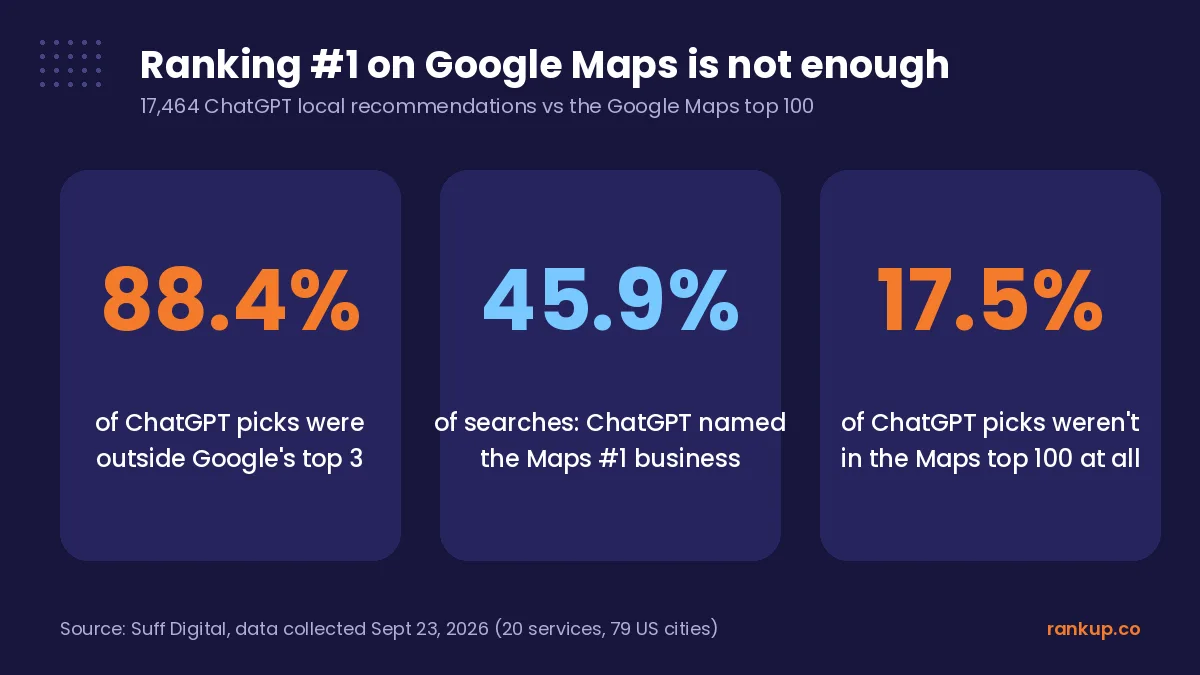
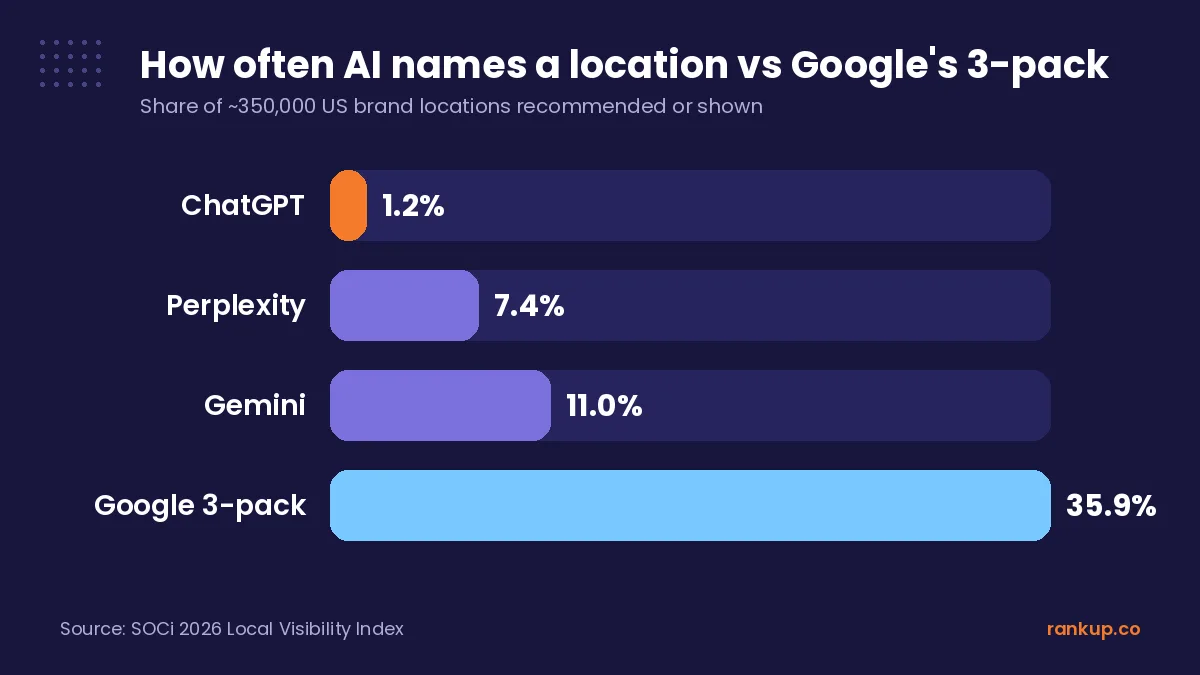
Put together, Google rank works more like an entry ticket than a guarantee. The businesses that keep winning AI answers also look trustworthy and clearly described everywhere else.
Seven reasons a top-ranked business gets skipped (and the fix for each)
1. Your website doesn’t say clearly what you do, where
Many local service sites cram every service onto one page and mention the city once in the footer. An AI assistant reading that page can’t confidently say you’re the right answer for “water heater replacement in Leeds” or “tankless water heater installer in Austin”. The experts surveyed for Whitespark’s report ranked dedicated pages for each service among the top factors for AI search visibility.
Fix: give each core service its own page that states the service, the areas you cover, typical pricing or what affects price, how long the job takes, and your licences or certifications. Write it in plain sentences a machine can quote. For home service businesses, this is the backbone of our home services marketing work.
2. You’re missing from the lists AI reads
When ChatGPT answers “best dentist in Manchester”, it leans on pages that already did that comparison: local “best of” roundups, city guides, industry directories and local news. Shaw’s advice in the Whitespark report is direct: “Get listed on expert-curated ‘best of’ lists. This is easier said than done.”
Fix: search your service and city in both Google and Bing, list every roundup and directory on page one, and work through them. Industry directories (Avvo for lawyers, Houzz for contractors, Healthgrades for clinics) usually matter more than general ones. We see this constantly in healthcare marketing for clinics and with law firms and other professional services.
3. All your reviews live on Google
If 100% of your reviews sit on your Google profile, an assistant that can’t read that profile easily has little to go on. BrightLocal’s 2026 survey also found the average consumer uses six different review sites when choosing a business.
Fix: keep asking for Google reviews, and add a second and third platform that matter in your industry, such as Yelp, Trustpilot, Facebook or a trade-specific site. Rotate which link you send so reviews build in more than one place. Respond to reviews too, because people who verify an AI pick will read your replies. Our brand reputation management service is built around exactly this.
4. Your business details don’t match across the web
SOCi’s finding that business details on ChatGPT were accurate for only about 68% of profiles is a warning. An assistant pulls your name, address, phone number and hours from many places. If your old address is still on a directory, or your hours differ between Yelp and your website, the model has a reason to trust a competitor instead.
Fix: audit your listings on Bing Places, Apple Business Connect, Yelp for Business, Facebook, the BBB and your top industry directories. Make your name, address, phone and hours identical everywhere, and fill every field each platform offers, including a clear description of your services in the first sentence.
5. Your rating sits below the bar
Google will still show a 3.8-star business in the map pack if it’s close and relevant. AI assistants seem less forgiving. SOCi describes reviews in AI search as working more like a filter for inclusion than a ranking factor, with recommended locations averaging 4.2 to 4.3 stars on ChatGPT and Perplexity.
Fix: work out why unhappy customers are unhappy and fix the operational cause, then ask every satisfied customer for a review in a steady rhythm. Never buy or gate reviews. It breaks platform rules and the pattern is easy to spot.
6. You’ve never looked at Bing
Because ChatGPT search draws on Microsoft as a search partner, a business that’s invisible in Bing starts at a disadvantage.
Fix: claim and complete Bing Places, verify your site in Bing Webmaster Tools, submit your sitemap, and search your top services in Bing to see where you stand.
7. Nobody else is talking about you
Local SEO practitioners, Shaw among them, argue that brand mentions across the web carry more weight in AI search than they did in classic rankings, even when there’s no link. Local press coverage, sponsorships, community pages, podcast appearances and genuine discussion on forums such as Reddit all add to the picture an assistant can find about you.
Fix: pick two or three realistic channels and work them every month. Sponsor a local team and get listed on its site, offer a useful quote to a local reporter, or publish something genuinely helpful that others want to reference, like a seasonal pricing guide for your trade.
A 30-day starting plan for a local service business
You don’t need a six-month programme to make progress. Here’s a realistic first month:
- Week 1, baseline. Ask ChatGPT, Gemini, Perplexity and Google AI Mode your top three “best [service] in [city]” questions. Use a logged-out or fresh session, repeat each question three times, and note who gets named and which sources are cited.
- Week 2, data cleanup. Fix your name, address, phone and hours across Bing Places, Apple Business Connect, Yelp, Facebook and your key industry directories. Claim anything unclaimed.
- Week 3, service pages. Rewrite or create one page per core service, with the area served, what’s included, price factors and proof such as licences, guarantees and real review excerpts.
- Week 4, reputation and mentions. Start a review request routine on a second platform, reply to recent reviews, and pitch at least three of the “best of” lists or directories the AI tools cited in week 1.
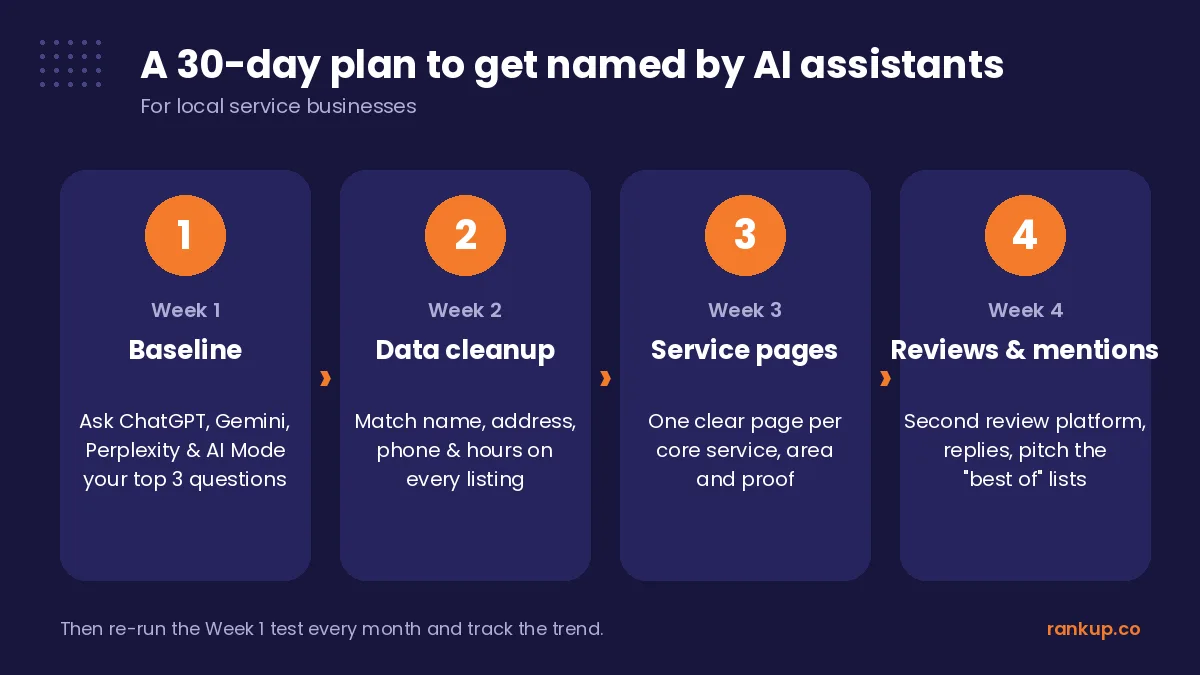
Then re-run the week 1 test every month. AI answers vary from day to day, so look for a trend across several checks rather than one result. If running these checks by hand gets tedious, it can be automated; that’s part of our AI consulting and marketing automation work.
How to check whether ChatGPT recommends your business
Ask the questions your customers would ask, in their words, such as “Who’s the best emergency electrician in Phoenix?” Click the sources ChatGPT cites, because those pages are your target list. If a competitor keeps appearing, look at where they’re mentioned and you’re not. That gap is usually your to-do list.
Frequently asked questions
Why doesn’t ChatGPT recommend my business when I rank well on Google?
ChatGPT doesn’t copy Google’s local rankings. It runs its own web searches, reads websites, directories, review sites and “best of” lists, then names the few businesses it can describe with confidence. A Suff Digital study of 17,464 ChatGPT recommendations (September 2026) found 88.4% were outside Google Maps’ top three, so a strong Google position helps but doesn’t guarantee a mention.
Does ChatGPT use my Google Business Profile?
Not the way Google’s own AI tools do. OpenAI says ChatGPT search uses search partners, with Microsoft among them, plus third-party providers for business listings. Google’s AI Overviews, AI Mode and Gemini can use Business Profile data directly, which is why Whitespark’s Darren Shaw scores some profile factors near zero for ChatGPT.
Do reviews affect whether ChatGPT recommends a business?
Yes. In SOCi’s 2026 Local Visibility Index, locations recommended by ChatGPT averaged 4.3 stars, and SOCi describes ratings as a filter for inclusion in AI answers. Reviews spread across several relevant platforms give AI tools more to read than reviews on Google alone.
How long does it take to start appearing in ChatGPT answers?
There’s no reliable published benchmark. Fixes to your own site and listings can be picked up as soon as they’re re-crawled, while earning “best of” list placements and mentions takes longer. Test the same questions every month and look for a trend, because AI answers vary from one day to the next.
Is AI search worth the effort if most of my leads still come from Google?
Most of the work overlaps. Clear service pages, consistent listings, strong reviews and local mentions help you in Google and in AI answers. With BrightLocal’s 2026 survey showing 45% of US consumers used AI tools to find a local business in the past year, it’s a channel worth covering while competitors ignore it.
Where Rankup fits
Most of this work is classic local SEO done thoroughly, plus reputation work that many agencies skip. Our SEO service covers local SEO, technical fixes, service-page content and AI search optimisation for Google AI Overviews, ChatGPT, Gemini and Perplexity. If you’d like to know where you stand today, book a free call and we’ll walk through what the AI tools currently say about your business and the first fixes worth making. You can also see results from past projects in our case studies.