If you own a roofing company in Ohio or a family law firm in Manchester, there’s a fair chance an agency has already pitched you this autumn on getting into ChatGPT ads before your competitors do. OpenAI opened its ads platform to self-serve advertisers in May, it now runs in 89 countries, and agencies are pitching it hard.
The honest answer for most local service businesses is “test small, and only after a few basics are in place.” Below is what ChatGPT ads are, what they cost, what the first independent data shows, and a capped test plan you can run without betting your Google budget on a channel that is less than a year old.
The short answer: should a local service business run ChatGPT ads?
If you already have a profitable Google Ads or Local Services Ads program, solid reviews, and call tracking, a small, time-boxed ChatGPT ads test is reasonable. You will learn how the platform behaves in your market while prices are still settling. If any of those pieces is missing, wait. The early numbers show paid ChatGPT clicks converting well below paid Google clicks, and nothing about ChatGPT ads will fix a weak reputation or a slow phone response.
What ChatGPT ads are and who sees them
ChatGPT ads appear below ChatGPT’s answer, labelled as sponsored. According to OpenAI’s advertiser help page, each ad shows your business name, logo, a headline, a short description, an image and a link to your landing page. Ads are matched to the context of the conversation, plus “context hints” you write about the topics where your service is relevant. OpenAI is clear that these hints are not exact-match keywords, so you get less control than you have in a Google Ads search campaign.
Three details matter more for local businesses than for national brands:
- Only part of the audience sees ads. OpenAI’s ads FAQ says ads appear for Free and Go users. People on Plus, Pro, Business, Enterprise and Edu plans, and users identified as under 18, don’t see them.
- Some industries are limited. Ads aren’t eligible to appear near personal health, mental health or political conversations. A dental clinic, physiotherapy practice or counselling service may find far fewer places for its ads to run than a plumber would.
- Buying ads doesn’t buy recommendations. OpenAI states that ads run on separate systems and don’t influence ChatGPT’s answers. If ChatGPT doesn’t name your business in its unpaid answer today, an ad won’t change that.
The scale is real. In its October 21, 2026 update, OpenAI said more than 1.2 billion people use ChatGPT each week and over 100,000 advertisers have run campaigns since ads launched. Scale tells you people are there. It doesn’t tell you whether a paid click from that audience turns into a booked job.
What ChatGPT ads cost in 2026
You can buy through a partner or set up an account yourself in OpenAI Ads Manager. OpenAI’s campaign setup guide lists three objectives: Views (billed per thousand impressions), Clicks (billed per click) and Conversions (still billed per click or per thousand impressions, never per conversion). The figures a local owner needs:
- Minimum daily budget: 25 USD, 15 EUR or 15 GBP per campaign, per OpenAI’s minimum spend table.
- Suggested starting bid for click campaigns: $3 to $5 per click, per OpenAI’s help page.
- A daily budget is an average over a seven-day week. Spend can reach twice your daily figure on a single day, so a campaign-total budget is the tighter control if you’re testing.
At those numbers, a 60-day test at the US minimum is roughly $1,500 in media. That’s affordable for most service businesses. The question is whether those clicks become calls, and that’s where the data gets less flattering.
What the early data says
Advertisers so far are mostly retail
Search intelligence firm Adthena published its Holiday AI Paid Search Report on November 4, 2026. It counted 204,489 ChatGPT ad placements between June and September across five holiday shopping categories, and the number of distinct advertisers in those categories grew from 1,082 in June to 6,333 in August. “Now there are three, and the newest one went from nothing to more than 200,000 placements in a matter of months,” Adthena CEO Phillip Thune said in the release, referring to ChatGPT joining Google Search and Google’s AI answers as places to buy search ads.
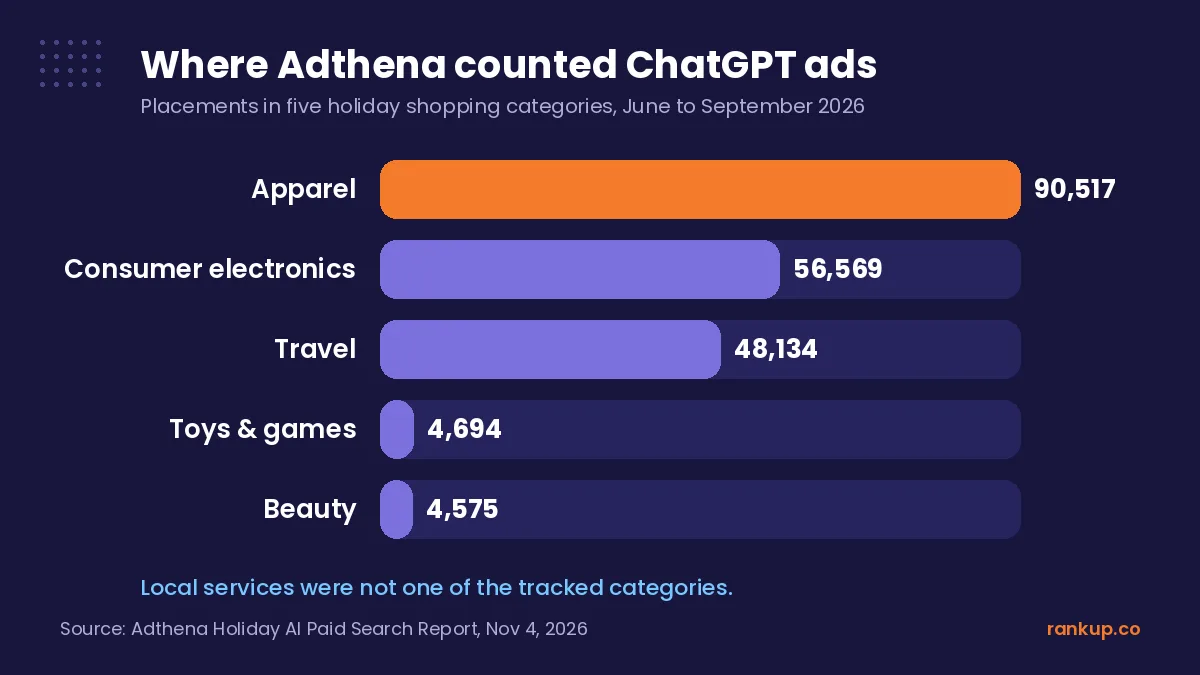
Read that report carefully before quoting it to a client or a boss. Apparel, electronics and travel make up about 95% of the placements, but those were three of the only five categories Adthena tracked. The report says nothing about plumbers, lawyers or HVAC companies, because it didn’t look at them. Its useful finding for service businesses is a different one: many ads ran against research-stage questions (“what’s the best…”), such as 69% of travel ads. People in ChatGPT are often comparing options, not ready to book.
Paid ChatGPT clicks are converting below paid Google clicks
The largest independent performance data so far comes from a working paper by researchers at the Frankfurt School of Finance & Management and the Vienna University of Economics and Business, “Can Advertising Fund Free AI?” (Kaiser and Schulze, 2026). It covers 1,898 online shops and nearly 10 billion visits from June 2025 to August 2026, with a paid-ads sample of 387 sites that received ChatGPT ad traffic.
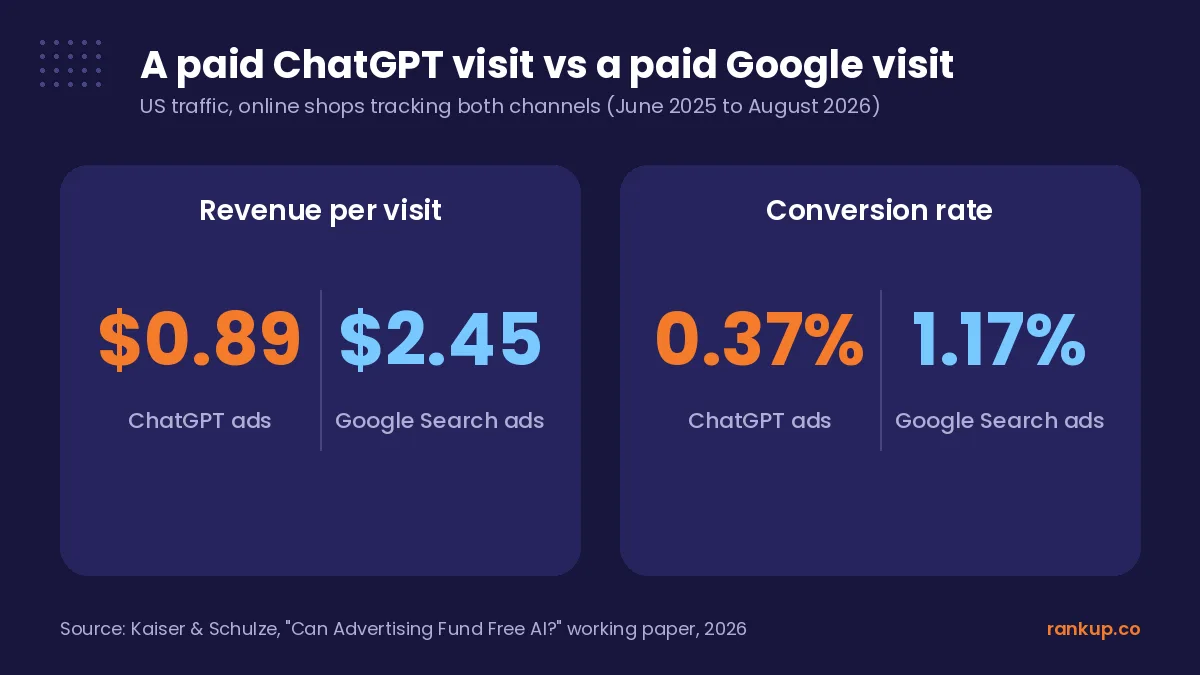
In US traffic, a paid ChatGPT visit produced $0.89 in revenue against $2.45 for a paid Google Search visit, and converted at 0.37% against 1.17%. The authors’ summary is blunt: paid ChatGPT visits “perform worst among major channels, offering less than a sixth of the value for money of paid Google Search.”
Two caveats keep this in proportion. The study measures online shops, where a “conversion” is a checkout, not a phone call about a leaking boiler. And the paper is still under review, with a small advertiser sample that chose to advertise rather than being randomly assigned. Treat it as an early warning, not a verdict. Local service businesses could see different results because their customers often call rather than buy online, and nobody has published a large study of that yet.
Why local service businesses are a different case
The arguments for testing are real. A single job for a roofer, a personal injury firm or a kitchen fitter can be worth thousands, so you can afford a much higher cost per lead than an apparel brand selling a $40 sweater. People also ask ChatGPT the kind of questions that come before a service purchase, like how much a new boiler should cost or whether a cracked foundation is urgent. OpenAI’s campaign guide says you can target supported states, cities, markets and postal codes where available, so you aren’t forced to buy a whole country.
The arguments for patience are just as real. Matching on conversation topics rather than exact keywords makes it harder to keep a “how to fix it myself” query away from your budget. The audience skews to free users. And the sale for most service businesses happens on the phone, which means every test lives or dies on whether you can tie a call back to the ad that produced it.
Who should test now
- Businesses with high job values and an established, profitable Google Local Services Ads or Google Ads program to compare against.
- Owners who already track calls and form leads by source and record which ones became booked jobs.
- Firms with a strong review profile in their area and a landing page that answers price and process questions clearly.
Who should wait
- Health-related practices, because of the sensitive-topic restrictions.
- Businesses still working out their Google Ads economics. Fix the proven channel first.
- Anyone without call tracking. You’ll see clicks and spend in Ads Manager, and no way to tell if a single job came from them.
Fix your reputation before you buy the click
Someone who clicks a ChatGPT ad for your business can ask ChatGPT about you in the next message, and they’ll get an unpaid answer built from your reviews, listings and mentions across the web. eMarketer’s Lisa Haiss made the point in her July 2026 analysis of local ChatGPT advertising: “Local businesses testing ChatGPT ads should treat reputation management as a prerequisite.” The same piece cites BrightLocal survey data showing that 33% of US consumers who had searched for a local business in the previous three months rejected one over negative reviews alone.
Before a test, make sure your Google reviews are recent and answered, your name, address, phone and hours match across directories, and ChatGPT’s own answer about your business is accurate. Our guide on why ChatGPT skips top-ranked local businesses walks through how to check that answer and improve it. If there are negative results or outdated claims about you online, our brand reputation management work is the place to start.
A capped 60-day test plan
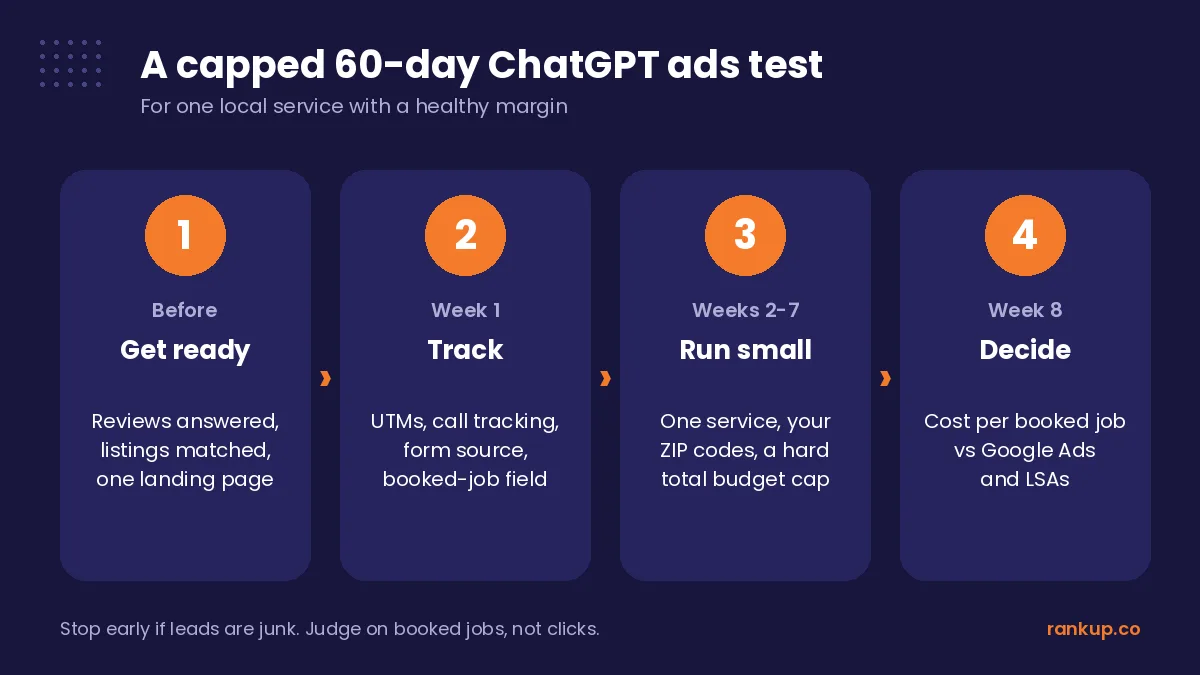
- Pick one service. Choose the service with the best margin and the clearest buying questions, for example emergency boiler repair, not “plumbing.”
- Build one landing page for it. Answer price range, timing, service area and what happens after someone calls, in the first screen. Put a tap-to-call number and a short form at the top.
- Set up tracking before you spend. Add UTM parameters to the landing page URL (OpenAI supports them), use a dedicated call-tracking number on that page, and confirm the source shows up in Google Analytics and your CRM. Add a “booked job” field so you can judge revenue, not leads.
- Target only where you work. Use the ZIP, postcode or city options available in your country. Check Ads Manager’s location picker rather than assuming a radius option exists.
- Cap the total spend. Use a campaign-total budget you’d be comfortable losing, and start with a click objective near OpenAI’s suggested $3 to $5 bid.
- Write context hints from real customer questions. Use the questions your team hears on the phone. Leave out DIY topics you don’t want to pay for.
- Review weekly, decide at day 60. Compare cost per booked job against your Google Ads and Local Services Ads numbers for the same service. If junk leads dominate after three weeks, stop early.
If you’d like a second opinion on whether your tracking and landing pages are ready for any new paid channel, our free paid ads readiness audit covers exactly that.
US, UK and EU: what’s different
The US has had ads the longest, since OpenAI began testing on February 9, 2026, and the most targeting options. The UK followed in August, and OpenAI announced ads in 31 European countries in the same month, starting with partners and its own sales team before self-serve access. Two points for European owners: OpenAI says personalized ads aren’t initially available in the European Economic Area or Switzerland, so ads there rely on the current conversation, and availability still varies by country. Check OpenAI’s Ads Manager availability page for your market before planning a budget, because this is changing month to month.
Frequently asked questions
Are ChatGPT ads worth it for a local business?
For most local service businesses, only as a small, capped test right now. Independent research on online shops (Kaiser and Schulze, 2026) found paid ChatGPT visits converted at 0.37% against 1.17% for paid Google Search. Local service results haven’t been studied at scale yet, so judge your own test on booked jobs.
How much do ChatGPT ads cost?
OpenAI sets a minimum daily campaign budget of 25 USD, 15 EUR or 15 GBP, and suggests a starting bid of $3 to $5 per click for click campaigns. The final price is set by auction. You can also buy on impressions, and conversion-optimised campaigns are still billed per click or per impression.
Will running ChatGPT ads make ChatGPT recommend my business?
No. OpenAI says ads run on separate systems and don’t influence ChatGPT’s answers. To appear in ChatGPT’s unpaid recommendations you need strong reviews, consistent listings and clear service pages across the web.
Can I target ChatGPT ads to my service area?
Yes, within limits. Beyond country targeting, OpenAI lets advertisers choose supported states or regions, cities, markets and postal codes where available, and options vary by country. Check the location picker in Ads Manager for what your market supports.
ChatGPT ads vs Google Ads: which should a local business fund first?
Google Ads and Local Services Ads, if they’re already profitable for you. They have years of performance data for local services and mature call tracking. Treat ChatGPT ads as an experiment funded on top of a working program, not money moved out of it.
Where Rankup fits
New ad channels deserve the same treatment as old ones: small, tracked and judged on revenue. Our paid media service covers Google Ads, Meta, LinkedIn and Reddit Ads, landing pages, conversion tracking and plain-language reporting for growing businesses in the US, UK and Europe. If you’re weighing ChatGPT ads, book a free call and we’ll tell you honestly whether your business is ready to test or better off waiting.