Picture a two-van plumbing company on a busy Tuesday. Both techs are under sinks, the office manager is out for lunch, and the phone rolls to voicemail. A homeowner listens to the greeting, waits a few seconds, hangs up without leaving a message and calls the next plumber on the list. A year ago that cost the business a job. Since October 1, 2026, if the call came through a Google Local Services ad, it can also cost a lead fee.
Google now counts some missed calls and voicemails as valid, chargeable leads. Below is what the rules say, what you can and can’t get credited, how the US and Europe differ, and the settings that stop you paying for calls nobody picked up.
The short answer: yes, missed calls can now be charged
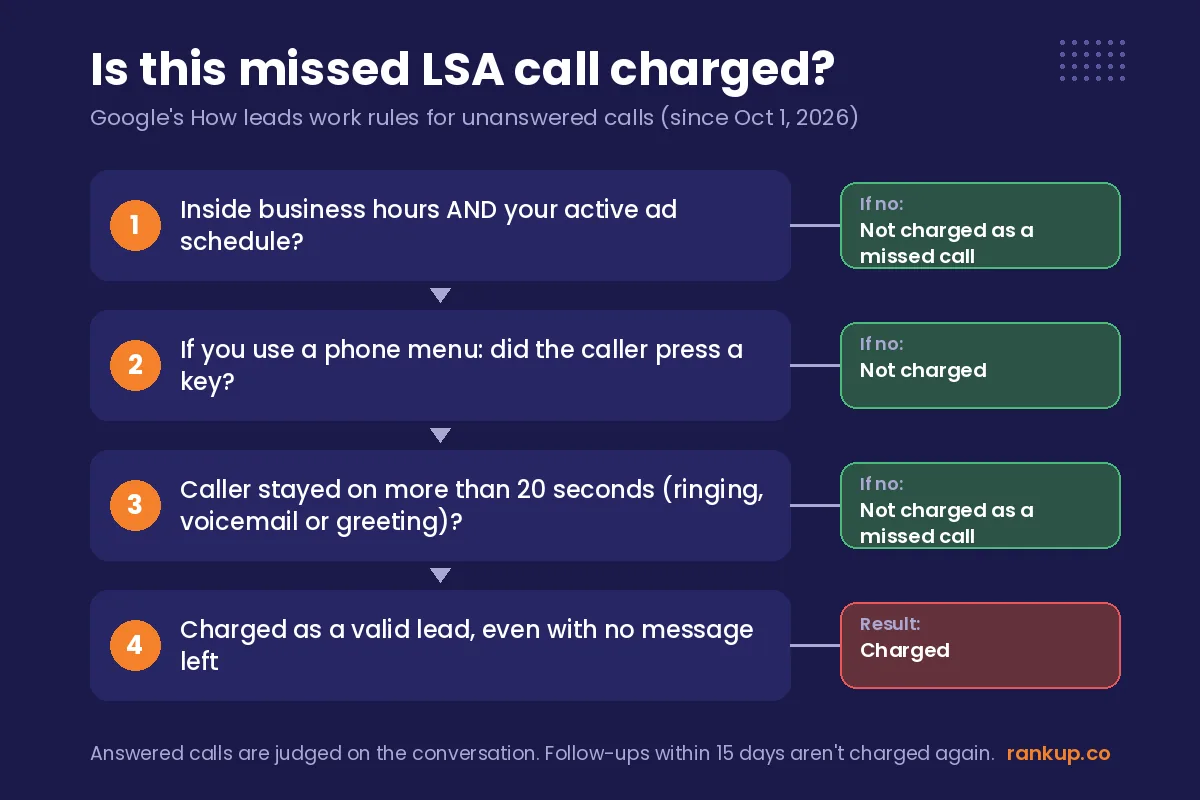
Google’s How leads work page for Local Services Ads lists this as a valid lead: you missed a phone call during your business hours and the customer stayed on the line for more than 20 seconds. A call that reaches voicemail or an automated greeting during business hours is treated as a connected call and charged under the same 20-second rule, whether or not the caller leaves a message.
So you pay for the lead and often lose the job as well, because a homeowner with a burst pipe rarely waits for a callback.
What changed on October 1, 2026
Search Engine Land reported on August 25, 2026 that Google had told advertisers about a new lead charge policy starting October 1. Google said the change rewards businesses with “excellent responsiveness.” Google also said it was adding safeguards against robocalls and spam calls, but didn’t explain how they work.
The old rules were kinder to busy owners. An archived June 2026 copy of the same help page said a missed call without a voicemail became a valid lead only when you returned the contact. Voicemails already counted. What’s new is that an unanswered call can be billed even if nobody at your business ever speaks to the caller.
On October 8, Search Engine Roundtable noted that Google had expanded the help page with these details.
How the 20-second rule works, call by call
Here is how Google’s current help page treats the common situations:
| What happens on the call | Charged? |
|---|---|
| You answer, even after a long ring | Judged as an answered call, based on the conversation. Ring time doesn’t matter. |
| Missed during business hours, caller stays on more than 20 seconds | Yes, it’s a valid lead |
| Voicemail or greeting during business hours, caller stays on more than 20 seconds | Yes, message or no message |
| Phone menu, caller hangs up before pressing a key | No, however long the menu played |
| Phone menu, caller presses a key and stays on more than 20 seconds after it | Yes |
| Short missed call, then you or the customer follow up | The follow-up is judged as an answered call |
| Same customer contacts you again within 15 days of the last interaction | Not charged again |
“Business hours” means your Google Business Profile hours
Google defines business hours as the hours set in your Google Business Profile. If your Local Services ad schedule differs, unanswered calls are only charged when they happen inside your active ad schedule and inside your business hours. That overlap is the window you’re paying for, and it’s the main thing you control.
Phone menus
If callers must press a key to be routed, the 20-second timer starts at the first key press. A caller who hangs up before pressing anything isn’t charged. Extra key presses in multi-level menus don’t restart the timer.
Follow-ups and the 15-day window
Once a lead is charged, follow-up calls or messages from the same phone number or email aren’t charged again as long as there’s interaction within 15 days. After 15 days of silence, a new contact from that customer can become a new charged lead. In practice, the call-back after a missed call is free if you make it quickly.
Can you dispute a missed-call charge?
Not the way you used to. Under the old system, US and Canadian advertisers could dispute a lead within 30 days. Google’s help page for the new Performance Max campaigns with pay-per-lead goals now says manual lead disputes are no longer supported. Instead, Google’s systems try to filter invalid activity before you’re charged and keep reassessing charged leads.
Here’s how lead credits work now:
- Charge statuses. Each lead on the Leads page shows as Charged, Not charged, In review or Credited. Google says it assesses lead quality over a 30-day period.
- Automatic credits. According to Google’s automated lead credits page, credits usually land within 30 days, and the original charge still appears on your invoice.
- Your feedback. Open the lead and complete the “Rate this lead” survey. Google says this starts an automated evaluation that can end in a credit.
- What tends to get credited. Google lists spam, solicitation, wrong numbers and duplicate callers within 15 days as invalid. It no longer credits “job type not serviced” or “geo not serviced” leads, so a caller asking for work you don’t do won’t come back as a credit.
Be realistic here. A real customer who called and got no answer is, by Google’s definition, a valid lead, so don’t expect credits for those. Rate leads accurately; Google says the feedback trains its models.
What does a missed call cost you?
Google doesn’t publish a fixed price per lead. Its help page says lead prices vary by location, job type, lead type and bidding mode, and that message leads are usually (not always) priced lower than phone leads. Google also doesn’t publish a separate price for missed-call leads, so the safe assumption is that a charged missed call costs about what your other phone leads cost.
To size your own leak, pull last month’s Leads report and work out:
- How many charged phone leads had no conversation (missed or voicemail).
- Your average charged phone lead price.
- How many of those callers never became booked jobs.
Missed calls times your lead price is the direct cost; the lost jobs are usually the bigger number. There’s a budget effect too: every charged lead counts toward your monthly maximum, and Google says your ad stops showing for the rest of the month once you hit it. A run of paid voicemails in week one can take you off the page in week four.
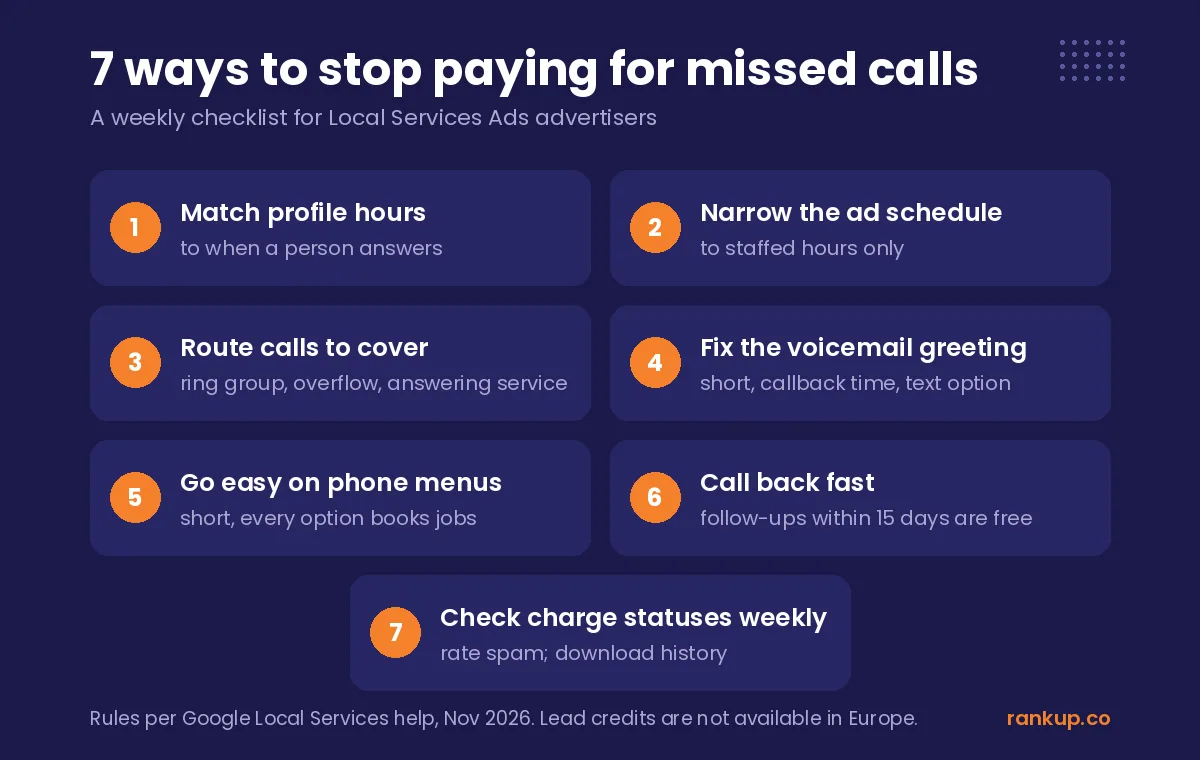
How to stop the leak: 7 fixes
1. Make your profile hours match when a person answers
If your Google Business Profile hours say 7 am to 7 pm but the phone is only reliably answered 8 to 5, the gap is a paid voicemail window. The trade-off: those hours show to everyone on Search and Maps, so shortening them may cost some organic calls. After the move into Google Ads, hours sync one way from your profile to your campaign.
2. Narrow the ad schedule instead, if you want to keep long hours
Because charges only apply where business hours and the ad schedule overlap, you can keep honest profile hours and run the ad only when someone is staffed. You’ll get fewer leads at the edges of the day, but you stop paying for calls you can’t take.
3. Route the ad number to a phone that gets answered
In Google Ads you can change the number your call and message leads route to. Point it at a line with cover, such as a ring group, a mobile that takes overflow from the office line, or a live answering service for lunch and evenings.
4. Make your voicemail greeting earn its fee
If voicemail is charged anyway, write the greeting for the caller who’s about to hang up. Keep it under ten seconds, say when you’ll call back, and mention that they can text the same number if that’s true for your setup. Then call back.
5. Think twice before adding a phone menu only to dodge charges
A menu does protect you from hang-ups before a key press. It also adds friction, and for urgent trades like plumbing, locksmiths or HVAC, a caller with a problem may give up on a menu. If you already use one, keep it short and make sure every option reaches someone who can book the job.
6. Call back fast, inside 15 days
The fee is spent. The job isn’t, yet. Follow-ups with the same customer within 15 days aren’t charged again, so a call-back inside a few minutes costs nothing extra. If your team is stretched, an automated text-back and call-back routine can help; that’s the kind of system our AI consulting team sets up for lead follow-up.
7. Check charge statuses weekly and save your history
Once a week, compare charged phone leads against the calls your team handled, and rate anything that looks like spam or a wrong number. If you’re still on the old dashboard, download your history now. Search Engine Land reported on November 17, 2026 that historical Local Services Ads reports can now be downloaded, covering total lead spend and charged phone, message and booking leads, but not impressions or clicks. Google says those reports won’t carry over into Google Ads.
US vs UK and EU: what’s different
Google’s getting started page offers Local Services Ads in the United States, Canada, the United Kingdom, Ireland, France, Germany, Italy, Spain, Austria, Belgium and Switzerland. The How leads work page doesn’t limit the 20-second missed-call rule to particular countries, but recourse differs a lot:
- Credits. Google says call recordings and lead credits aren’t available for any verticals in Europe, and automatic lead credits aren’t available for accounts in European Economic Area countries. In the US, health care and tax specialist advertisers can’t get credits or recordings either.
- Bookings. Booking leads are only available in the US and Canada.
- Timing of the move to Google Ads. Google’s migration page says US home and storefront services started moving in August 2026, service-area businesses follow in late 2026, and non-US accounts move in 2027.
For a UK or EU business, a paid voicemail is very hard to get back, so hours, scheduling and call cover matter even more.
What about “Google Guaranteed” leads?
The Google Guaranteed badge is gone. In an August 2025 announcement, Google said a single Google Verified badge would replace Google Guaranteed, Google Screened, License Verified by Google and the Money Back Guarantee, starting October 2025. Verified status carries over into Google Ads, and the badge doesn’t change how leads are charged.
What’s still unclear
A few things Google hasn’t spelled out, so treat these as open questions rather than settled rules:
- How the new robocall and spam safeguards decide what to filter.
- After-hours voicemails. The voicemail rule names business hours, but the list of valid leads includes “a voicemail from the customer” with no hours attached. Check the charge status of any after-hours voicemail on your Leads page.
- How the 20-second wording carries over to Performance Max pay-per-lead campaigns, whose help page refers to “minimum call duration requirements” without a number.
Weighing LSAs against newer channels? Our guide to ChatGPT ads for local service businesses covers how to test one without starving what already works.
Frequently asked questions
Does Google charge for missed calls on Local Services Ads?
Yes, since October 1, 2026. A call you miss during your business hours is a valid lead if the caller stays on the line for more than 20 seconds. If you use a phone menu, the 20 seconds start after the caller’s first key press.
Am I charged if a caller reaches my voicemail?
During business hours, yes. Google treats voicemail or an automated greeting as a connected call and charges it if the caller stays on for more than 20 seconds, whether or not they leave a message.
How do I dispute a Local Services Ads lead in 2026?
Manual disputes are no longer supported. Open the lead on the Leads page in Google Ads and complete the “Rate this lead” survey. That starts an automated review, and any credit shows in the Charge Status column, usually within 30 days.
How much does a Local Services Ads lead cost?
Google doesn’t publish a set price. Lead prices vary by location, job type, lead type and bidding mode, and message leads are usually cheaper than phone leads. Your own Leads report is the only reliable source for your market.
Do the missed-call rules apply in the UK and EU?
Google’s help page doesn’t limit the 20-second rule by country. European advertisers can’t get lead credits or call recordings, so preventing missed calls matters even more there.
Where Rankup fits
Local Services Ads work well for a lot of service businesses, but the economics now depend on how fast your phone gets answered. Our paid media service covers Google Ads, Local Services Ads and conversion tracking for home service businesses and other local firms in the US, UK and Europe. If you’d like a second pair of eyes on your hours, routing and charged leads, start with our free paid ads readiness audit.